Documentation Index
Fetch the complete documentation index at: https://langchain-5e9cc07a-preview-featse-1779998369-ad736a3.mintlify.app/llms.txt
Use this file to discover all available pages before exploring further.
This page documents what the Azure Terraform modules provision and how the modules wire the resulting deployment together.
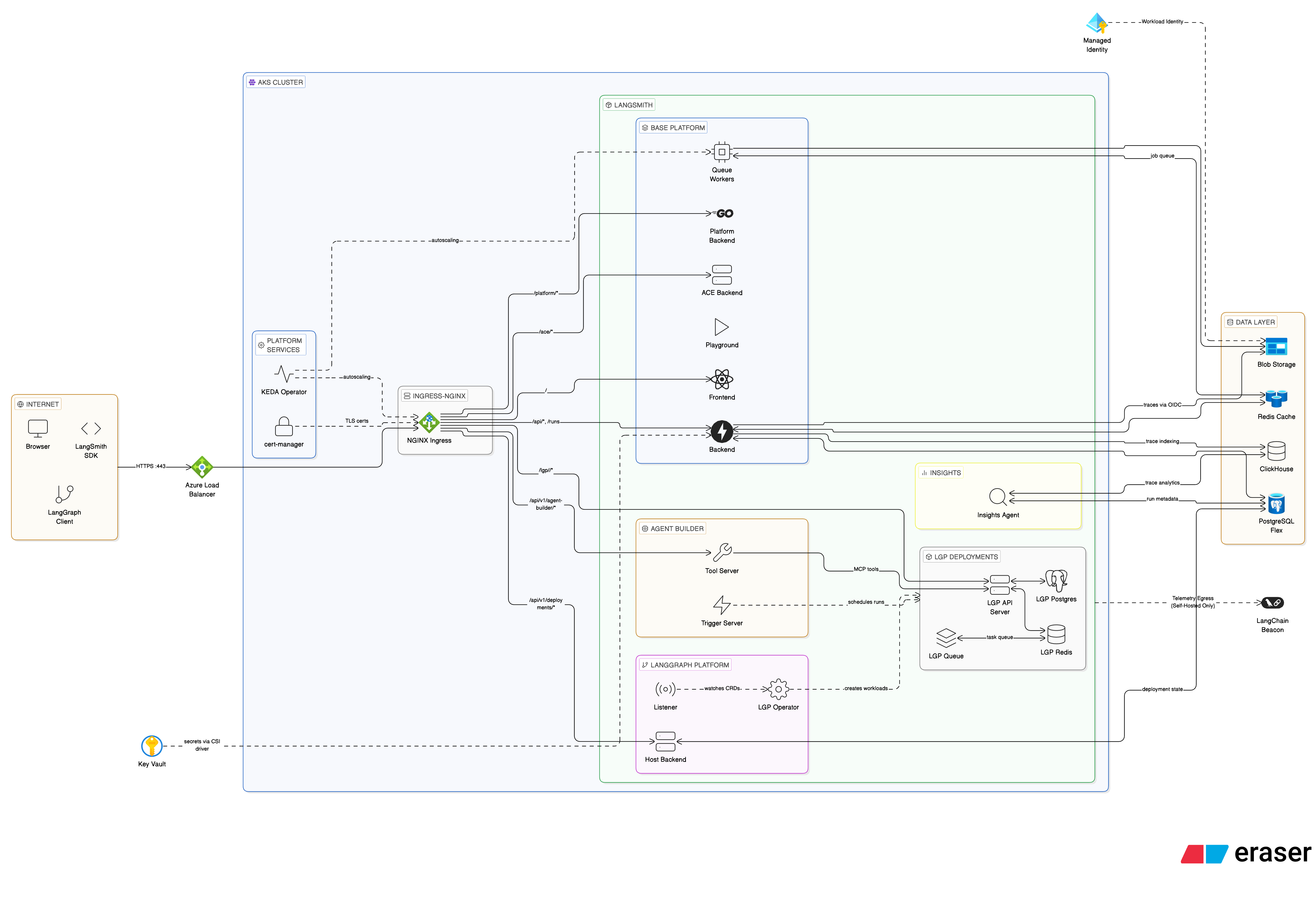
LangSmith on Azure deploys in stages. Each stage adds a capability layer on top of the previous. All layers share the same AKS cluster and langsmith namespace.
| Stage | Layer | What it adds |
|---|
| Infrastructure | Azure infrastructure | VNet, AKS, Postgres, Redis, Blob, Key Vault, cert-manager, KEDA, ingress controller |
| Application | LangSmith base | frontend, backend, platform-backend, queue, ingest-queue, ace-backend, clickhouse, playground |
| LangSmith Deployment add-on | LangSmith Deployment | host-backend, listener, operator + per-deployment pods |
| Agent Builder add-on | Agent Builder | agent-builder-tool-server, agent-builder-trigger-server + deep-agent LGP |
| Insights + Polly add-on | Insights + Polly | Clio analytics (ClickHouse-backed), Polly eval agent (operator-managed, dynamic) |
Application deployment paths
| Path | How | When to use |
|---|
| Helm path | make init-values && make deploy | Default. Shell script, interactive, reads TF outputs dynamically. Best for first deploys and day-2 re-deploys. |
| Terraform path | make init-app && make apply-app | Declarative. Kubernetes Secrets + langsmith-ksa SA + Helm release in Terraform state. Best for GitOps and CI/CD pipelines. |
The Terraform path uses the app/ module. make init-app calls app/scripts/pull-infra-outputs.sh to read all infra outputs and write them into app/infra.auto.tfvars.json.
Deployment tiers
Light deploy (all in-cluster)
AKS Cluster
├── langsmith namespace
│ ├── frontend, backend, platform-backend, playground, queue, ace-backend
│ ├── clickhouse (in-cluster pod)
│ ├── postgres (in-cluster pod)
│ └── redis (in-cluster pod)
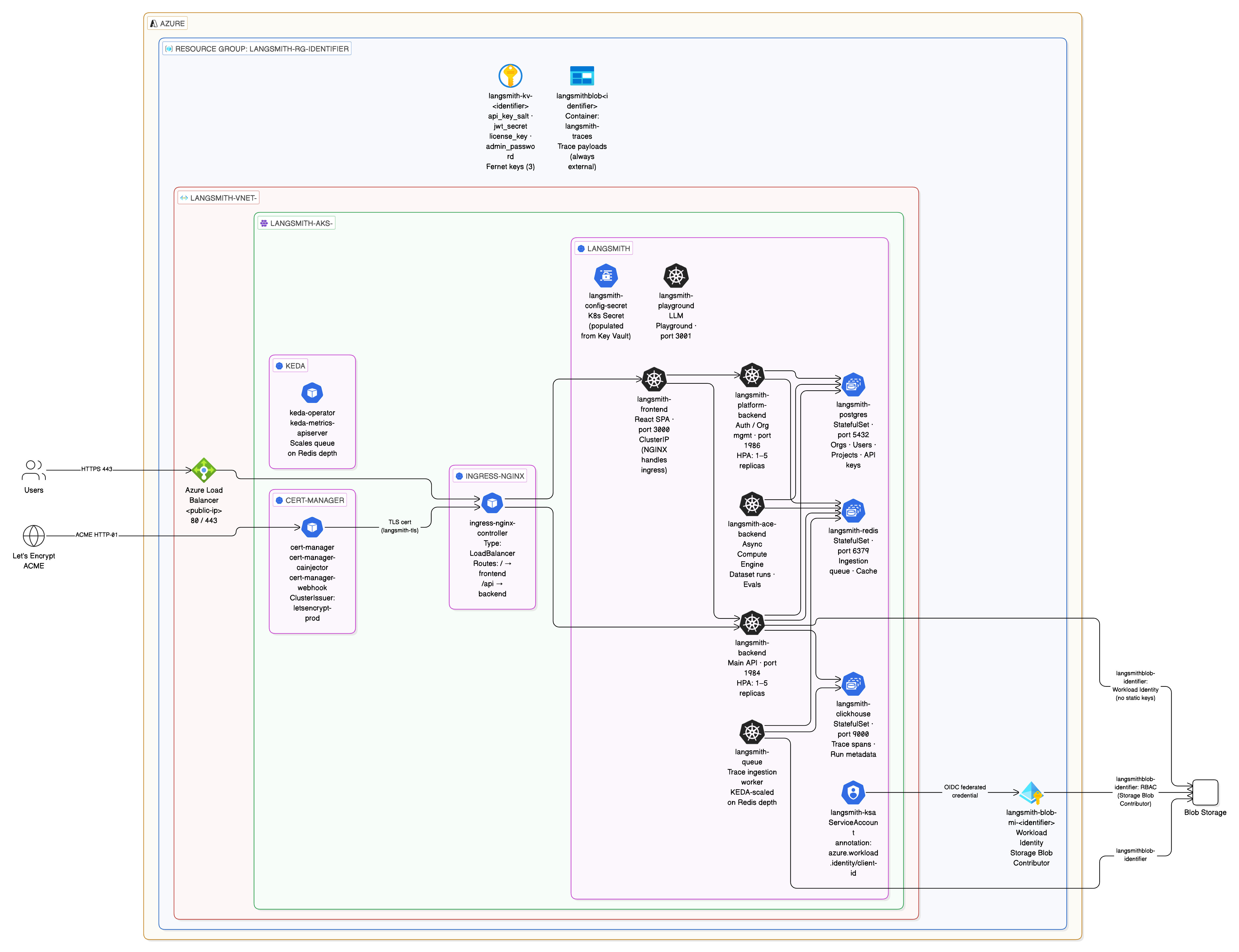
├── ingress-nginx (Azure Load Balancer → NGINX)
└── cert-manager (Let's Encrypt TLS)
Azure
├── Azure Blob Storage (trace payloads — always external)
└── Azure Key Vault (secrets)
Set in terraform.tfvars:
postgres_source = "in-cluster"
redis_source = "in-cluster"
clickhouse_source = "in-cluster"
For the full all-in-cluster walkthrough (Front Door TLS, all-in-cluster DBs), see BUILDING_LIGHT_LANGSMITH.md in the Azure module repo.
Production (external managed services)
AKS Cluster
├── langsmith namespace
│ ├── frontend, backend, platform-backend, playground, queue, ingest-queue, ace-backend
│ └── clickhouse (in-cluster — use LangChain Managed for production scale)
└── ingress-nginx + cert-manager
Azure Managed Services
├── Azure DB for PostgreSQL Flexible Server (private VNet)
├── Azure Cache for Redis Premium (private VNet)
├── Azure Blob Storage (Workload Identity — no static keys)
└── Azure Key Vault
Networking
Light deploy
langsmith-vnet<identifier>
└── subnet-0 (AKS nodes only)
No Postgres/Redis subnets — chart-managed pods handle both
Production
langsmith-vnet<identifier>
├── subnet-0 (AKS nodes)
├── subnet-postgres (Azure DB for PostgreSQL Flexible Server)
└── subnet-redis (Azure Cache for Redis Premium)
All subnets are private. Postgres and Redis are accessible only from within the VNet via private DNS resolution. No public endpoints.
Application core services
| Service | Purpose | Port | HPA | Workload Identity |
|---|
langsmith-frontend | React UI | 3000 | 1 to 10 | No |
langsmith-backend | Main API (traces, runs, projects, API keys, feedback) | 1984 | 3 to 10 | Yes (Blob) |
langsmith-platform-backend | Org and user management, auth, billing, settings | 1986 | 1 to 10 | Yes (Blob) |
langsmith-playground | LLM prompt playground UI | 3001 | 1 to 10 | No |
langsmith-queue | Trace ingestion worker (Redis → ClickHouse + Blob) | — | 3 to 10 + KEDA | Yes |
langsmith-ingest-queue | Dedicated high-throughput ingestion worker | — | 3 to 10 + KEDA | Yes |
langsmith-ace-backend | Async compute (dataset runs, evaluations, background jobs) | — | 1 to 5 | No |
langsmith-clickhouse | Columnar store (trace spans, run metadata, eval results) | — | StatefulSet, single replica, 500Gi PVC | No |
In-cluster ClickHouse is dev/POC only (single pod, no replication, no backups). For production use LangChain Managed ClickHouse or a self-managed external cluster.
One-time jobs
| Job | Purpose |
|---|
langsmith-backend-migrations | PostgreSQL schema migrations |
langsmith-backend-ch-migrations | ClickHouse schema migrations |
langsmith-backend-auth-bootstrap | Creates the initial org and admin account from initial_org_admin_password in langsmith-config-secret |
LangSmith Deployment add-on
| Service | Purpose | Workload Identity |
|---|
langsmith-host-backend | LangGraph control plane API. Manages deployment lifecycle, serves deployment metadata. | Yes |
langsmith-listener | Watches host-backend for state changes, creates and updates LangGraphPlatform CRDs. | Yes |
langsmith-operator | Kubernetes operator. Azure-specific: injects azure.workload.identity/use: "true" + langsmith-ksa so every agent pod accesses Blob Storage via Workload Identity. | No |
Agent Builder add-on
| Pod | Type | Role | Workload Identity |
|---|
langsmith-agent-builder-tool-server | Static | MCP tool execution server | Yes |
langsmith-agent-builder-trigger-server | Static | Webhook receiver and scheduled trigger engine | Yes |
langsmith-agent-bootstrap | Job | Registers the bundled Agent Builder agent | — |
agent-builder-<hash> + queue + redis + lg-<hash>-0 | Dynamic | Agent Builder deployment, operator-managed | Inherited |
Insights and Polly add-on
Insights/Clio: No static pods. Deploys lazily as a dynamic LangGraph deployment via the operator on first UI invocation. Reads insights_encryption_key from langsmith-config-secret. Never rotate this key — it permanently breaks existing Insights data.
Polly: Runs as a dynamic LangGraph deployment. Resource limits 2 CPU / 4 Gi request, 4 CPU / 8 Gi limit, scales 1 to 5 replicas. Reads polly_encryption_key from langsmith-config-secret. Same rotation warning as Insights.
Azure managed services
When postgres_source = "external" and redis_source = "external" (the recommended production setting), Terraform provisions:
Azure DB for PostgreSQL Flexible Server
- Holds orgs, users, projects, API keys, settings.
- PostgreSQL ≥ 14 required (Azure Flexible Server defaults to 16).
- Extensions enabled automatically by the
postgres module: btree_gin, btree_gist, pgcrypto, citext, ltree, pg_trgm.
- Private VNet only (
subnet-postgres), SSL port 5432.
- Secret:
langsmith-postgres-secret, created by the k8s-bootstrap Terraform module.
Azure Cache for Redis Premium
- Trace ingestion queue, pub/sub, short-lived cache.
- Redis ≥ 5 required (Premium tier defaults to Redis 6).
- Each LangSmith installation must use its own dedicated Redis. Shared instances cause deployment tasks to route incorrectly.
- Private VNet only (
subnet-redis), TLS port 6380.
- Secret:
langsmith-redis-secret, created by the k8s-bootstrap Terraform module.
Azure Blob Storage
- Trace payloads: large inputs and outputs, attachments.
- Workload Identity (no static keys) via the
k8s-app-identity Managed Identity.
- Always required. Disabling blob storage breaks the cluster on large payloads.
- Prefixes:
ttl_s/ (14-day TTL), ttl_l/ (400-day TTL).
Azure Key Vault
- Centralized secret store for all LangSmith secrets.
- Secret flow:
az keyvault secret show → kubectl create secret generic langsmith-config-secret.
Workload Identity
Azure AD token exchange happens via the AKS OIDC issuer. Pods access Blob Storage without static keys.
AKS OIDC issuer
→ Federated credential on Azure Managed Identity (one per Kubernetes ServiceAccount)
→ Kubernetes ServiceAccount annotated with azure.workload.identity/client-id
→ Pod labeled with azure.workload.identity/use: "true"
→ Azure AD issues a short-lived token — no storage keys in any Secret or env var
Workload Identity is centralized in modules/k8s-cluster/ alongside the managed identity and OIDC issuer, which avoids circular dependencies and simplifies adding new ServiceAccounts.
Which pods need Workload Identity
Every pod that reads blob storage env vars must have:
- A federated credential registered in Terraform (
modules/k8s-cluster/main.tf).
- The
azure.workload.identity/use: "true" label on the Deployment.
- The
azure.workload.identity/client-id annotation on the ServiceAccount.
| Pod | Stage | Needs WI |
|---|
langsmith-backend | Application | Yes |
langsmith-platform-backend | Application | Yes |
langsmith-queue | Application | Yes |
langsmith-ingest-queue | Application | Yes |
langsmith-host-backend | LangSmith Deployment add-on | Yes |
langsmith-listener | LangSmith Deployment add-on | Yes |
langsmith-agent-builder-tool-server | Agent Builder add-on | Yes |
langsmith-agent-builder-trigger-server | Agent Builder add-on | Yes |
langsmith-frontend | Application | No |
langsmith-playground | Application | No |
langsmith-ace-backend | Application | No |
langsmith-clickhouse | Application | No |
langsmith-operator | LangSmith Deployment add-on | No |
All federated credentials are registered in modules/k8s-cluster/main.tf under service_accounts_for_workload_identity. Adding a new pod that accesses blob storage requires adding its ServiceAccount name to that list and running terraform apply -target=module.aks.
What breaks without it
panic: blob-storage health-check failed: get container properties failed:
DefaultAzureCredential: failed to acquire a token.
WorkloadIdentityCredential authentication failed.
AADSTS700213: No matching federated identity record found for presented assertion subject
The pod panics on startup — the ServiceAccount has no registered federated credential so Azure AD rejects the token exchange.
Secret flow
Infrastructure stage
./setup-env.sh (read-only against Key Vault — never writes to KV directly)
First run: prompts for postgres password, license key, admin password.
Generates api_key_salt, jwt_secret, Fernet keys locally.
Key Vault does not exist yet → writes to local dot-files + secrets.auto.tfvars.
Subsequent: Key Vault exists → reads all secrets from KV → writes to secrets.auto.tfvars.
No prompts, no generation, no KV writes.
Output: secrets.auto.tfvars (gitignored, chmod 600)
Terraform picks this up automatically — no shell session coupling.
terraform apply
Reads: terraform.tfvars (non-sensitive config)
secrets.auto.tfvars (sensitive values — sole input for KV secret creation)
Creates: Azure Key Vault + all secrets as KV secrets (Terraform is the sole KV writer)
Application stage
./setup-env.sh (re-run on any machine to refresh secrets.auto.tfvars from Key Vault)
kubectl create secret generic langsmith-config-secret
Reads: Key Vault secrets + Terraform outputs (postgres/redis URLs, blob account)
Writes: K8s secrets — langsmith-config-secret, langsmith-postgres-secret,
langsmith-redis-secret
helm upgrade --install langsmith ...
Chart reads config.existingSecretName = "langsmith-config-secret".
No secrets inline in any YAML file.
Key rule: secrets.auto.tfvars is never committed. It is regenerated from Key Vault on any machine by running ./setup-env.sh. Terraform is the sole writer to Key Vault; setup-env.sh only reads from it after the first apply.
Ingress options
| Controller | Variable | DNS label support | Notes |
|---|
nginx (default) | ingress_controller = "nginx" | Yes | NGINX via Helm, standard Kubernetes Ingress. |
istio-addon | ingress_controller = "istio-addon" | Yes | AKS managed Istio service mesh. Use istio_addon_revision to pin revision. |
istio | ingress_controller = "istio" | Yes | Self-managed Istio via Helm. Full control over revision and config. |
agic | ingress_controller = "agic" | Yes | Azure Application Gateway v2 + AGIC Helm chart. Native L7 WAF. HTTP-only or dns01 + custom domain. |
envoy-gateway | ingress_controller = "envoy-gateway" | Yes | Gateway API native. Uses envoyproxy/gateway-helm. |
none | ingress_controller = "none" | — | Bring your own ingress. |
Azure Public IP DNS labels (dns_label) work with all controllers. deploy.sh applies the service.beta.kubernetes.io/azure-dns-label-name annotation to the correct LoadBalancer service based on the chosen controller.
For the full TLS compatibility matrix and per-controller setup, see INGRESS_CONTROLLERS.md in the Azure module repo.
Resource sizing
Four sizing profiles are available.
| Profile | Use case | Set via |
|---|
minimum | Cost parking, CI smoke tests, single-user demos | sizing_profile = "minimum" in terraform.tfvars |
dev | Developer use, integration tests, POCs | sizing_profile = "dev" |
production | Real traffic — multi-replica + HPA | sizing_profile = "production" (recommended) |
production-large | ~50 users, ~1000 traces/sec | sizing_profile = "production-large" |
AKS node pools
| Pool | VM Size | vCPU | RAM | Min | Max | Purpose |
|---|
| default | Standard_D8s_v3 | 8 | 32 GB | 3 | 10 | Core LangSmith, system pods |
| large | Standard_D16s_v3 | 16 | 64 GB | 0 | 2 | ClickHouse (in-cluster), LGP agent pods |
ClickHouse (when in-cluster) requests 2 to 4 CPU and 8 to 15 GB RAM depending on profile. With LangChain Managed ClickHouse, the large pool is only needed for LGP operator-spawned agent pods.
Optional modules
Each module is count-controlled (0 disabled, 1 enabled). Enable any combination; the core deployment (Passes 1 to 5) works without them.
| Module | Variable | Use case |
|---|
waf | create_waf = true | Azure WAF policy (OWASP 3.2 + bot protection). Attach to Application Gateway. |
diagnostics | create_diagnostics = true | Log Analytics workspace + diagnostic settings for AKS, Key Vault, Blob. Recommended for production observability. |
bastion | create_bastion = true | Azure Bastion (Standard tier). Browser-based SSH to node VMs without a public IP. |
dns | create_dns_zone = true | Azure DNS zone + A record. Required for DNS-01 cert issuance with a custom domain. |